You have no items in your shopping cart.
Utilizing Prey Drive For the Sporting Dog
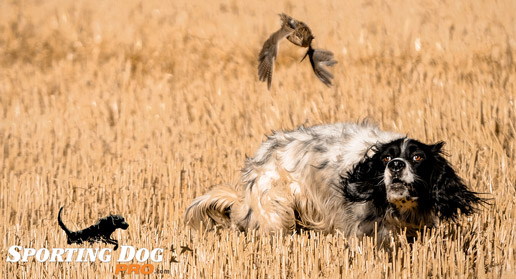
Prey drive is the quality that separates a dog that hunts from a dog that goes along for the walk. It’s the instinctive compulsion to find, pursue, and capture prey — the internal engine that keeps a dog working when the scent goes cold, that drives him into cover that would stop a less motivated dog, and that produces the focused, persistent effort that makes a working gun dog genuinely useful rather than just pleasant to have along. Understanding prey drive — what it is, how it works, what it looks like at different intensity levels, and how to channel it — is foundational knowledge for anyone training or working with a sporting dog.
What prey drive actually is
Prey drive is not aggression. These two things are frequently confused, and the confusion leads to both misunderstanding the behavior and mishandling it. Aggression is threat-based and defensive in motivation. Prey drive is predatory and appetitive — it’s driven by desire rather than fear or threat. A dog with high prey drive pursuing a bird is in a fundamentally different psychological state than an aggressive dog reacting to a threat. The prey-driven dog is engaged, focused, forward-moving, and positively aroused. That state is an asset to work with, not a problem to suppress.
Prey drive in sporting dogs is the product of centuries of selective breeding toward specific behavioral tendencies. The pointer’s instinct to freeze and indicate birds rather than chase them to ground is a modified prey drive sequence — the stalk and freeze component intensified and the capture component interrupted. The retriever’s drive to chase a falling bird, pick it up, and bring it back is prey drive redirected through the retrieve. The scent hound’s compulsion to follow a track regardless of how old or cold it becomes is prey drive expressed through nose work. In every case, the raw drive is the engine and the training channels it into useful field behavior.
Prey drive exists on a spectrum
Not every dog has the same level of prey drive, and the right level depends on the application. You’ve seen both ends of the spectrum in the field: the dog that is genuinely a joy to watch hunt, works persistently and intelligently, and makes his handler look like a genius — and the dog whose uncontrolled intensity makes the day exhausting, who ignores commands in pursuit of anything that moves, and whose handler spends more time managing him than hunting. The first dog has strong prey drive with adequate structure to channel it. The second dog has strong prey drive without the training to direct it productively.
A dog with moderate to low prey drive presents a different challenge — getting him to engage with work that doesn’t naturally excite him and building the motivation needed to sustain effort through a hard day. Both too much and too little are training challenges, though most hunters would take the challenge of channeling high drive over the challenge of building drive that isn’t there.
Starting with genetics — working with a breeder
Prey drive is largely heritable. A dog from a line of proven field performers with generations of strong working instinct is more likely to have the drive level appropriate for hunting work than a dog from a line without that history. The best place to start if prey drive is a priority is with a breeder who can speak specifically about the working instincts of the sire and dam — not just their titles or their appearances, but what they’re actually like in the field. Ask whether the parents hunt. Ask about siblings from previous litters. Ask the breeder to show you the dogs working if possible.
That said, drive level varies within litters even from high-drive parents. The puppy evaluation at seven to eight weeks can give an experienced eye a reasonable read on relative drive levels within a litter, though final expression takes time and the right environment to develop.
Building and channeling drive through training
Even a dog with excellent natural drive needs training to make that drive useful rather than chaotic. The goal isn’t to reduce the drive — it’s to channel it through the behaviors you want and teach the dog to hold his intensity in situations that require it while releasing it productively when it’s called for.
Introduce birds early. A puppy that can legally and safely be exposed to birds should be. The connection between the dog’s natural prey instinct and live birds is the foundation everything else builds on. Bird wings and scented dummies are a practical way to make that introduction before live birds are available — they carry real bird scent and trigger the prey response in most dogs with good drive. But live birds, introduced as soon as the dog shows genuine interest and the handler is ready to manage the experience constructively, accelerate drive development faster than any other tool.
Keep early training sessions short. A puppy has a short attention span and the goal of early sessions is to leave the dog wanting more — not to exhaust the drive through long repetitive sessions that make the work boring. End while the dog is still enthusiastic. The drive should be building between sessions, not being depleted by them.
The e-collar and high-drive dogs
The dog with intense prey drive and strong natural instincts has a specific training challenge: at the moment the drive fires — when birds are in the air, when the retrieve is in progress, when the scent is hot — the handler’s voice and physical proximity may not be enough to enforce the standard you’ve established in training. The dog that holds his point beautifully in the yard may creep at the flush when everything in his biology is screaming at him to go. The retriever that is steady in practice may break at the shot when a bird falls close.
This is exactly the application where a training collar with multiple stimulation levels earns its place. The collar provides precise, timely communication at the moment the behavior is happening — not a second later, not from across the field, but at the instant the dog starts to break, creep, or disengage from the expected behavior. For a high-drive dog, the collar’s ability to deliver a correction calibrated to the dog’s sensitivity and matched to the intensity of the moment is the tool that makes the drive productive rather than uncontrollable.
High-drive dogs that receive appropriate training early are among the most rewarding sporting dogs to work with. The drive that requires management in a young dog becomes the engine of exceptional field performance in a trained adult. The investment in structured early training pays back across every season of the dog’s working life.
Prey drive as a training tool
One of the most effective principles in working dog training is using the retrieve itself — the fulfillment of the prey drive sequence — as the primary reward for correct behavior. A retrieve earned by completing the task correctly is more motivating for a high-drive dog than food, more meaningful than praise, and more directly connected to the work the dog is built for. A steady dog that holds his point through flush and shot and then gets sent to retrieve has been rewarded in the most fundamental way possible for a dog whose entire orientation is toward birds.
This is the art of working with prey drive rather than against it: setting up training scenarios where the drive is the engine, the correct behavior is the path to fulfilling it, and the reward is the fulfillment itself. A dog trained this way isn’t complying to avoid consequences — he’s working because working is what he most wants to do, and the training has given him a productive channel for that want.